The math in enclose.horse
I’ve lately been hooked to this simple game called enclose.horse. I figured: since i liked winning at it, why not solve it?
The game
The rules are simple:
- You have walls;
- you can place them on grass tiles;
- the horse moves up, down, left, and right, never diagonally;
- existing obstacles like water and rocks already block movement;
- if the horse reaches the edge of the grid, it escapes;
- your score comes from the tiles trapped inside.
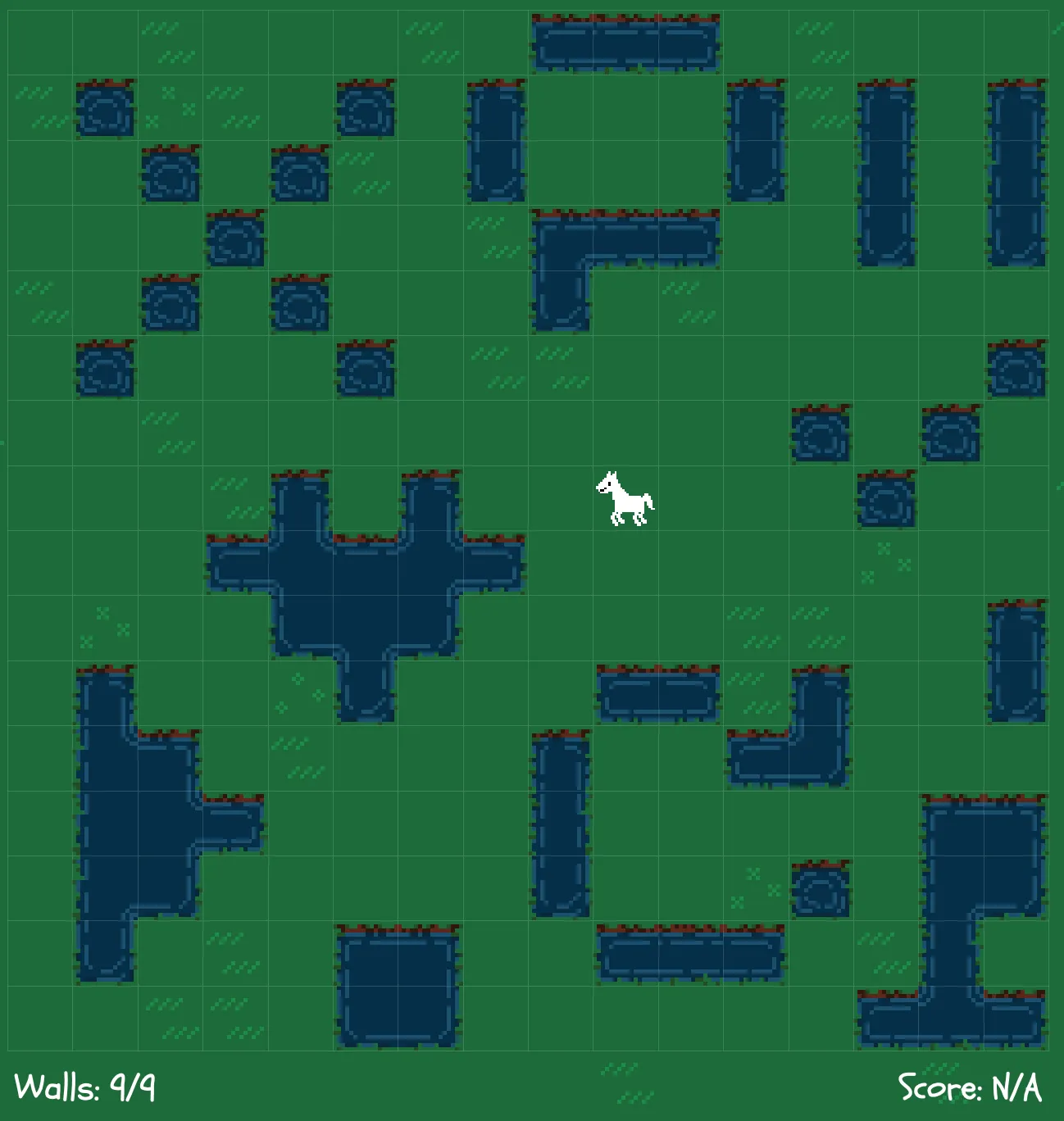
To make it more interesting, there are a few extras:
- tiles with a cherry give you a
+3point bonus; - tiles with a golden apple give you a
+10point bonus; - tiles with a bee swarm apply a
-5penalty; - portals can teleport the horse from one portal tile to the other.
The game reduces to:
Block a set of cells so the horse’s region is cut off from the outside, while maximizing the score of that region.
The model
Lets work up from a simplified version of the game.
Trapping the horse
A good place to start is with the first part of the problem: block a set of cells so the horse’s region is cut off from the outside. Forget scoring, forget the wall limit, and ask the simplest possible question:
What is the fewest walls that trap the horse at all?
Since we are trying to block all paths, this is a paths problem — and paths problems ask for graphs.
- every accessible cell is a vertex;
- every legal horse move is an edge;
- every blocked cell is removed from the graph;
- and the entire outside world is one extra special vertex , joined to every boundary cell the horse could escape through (this is to account for the horse being able to move outside the map)
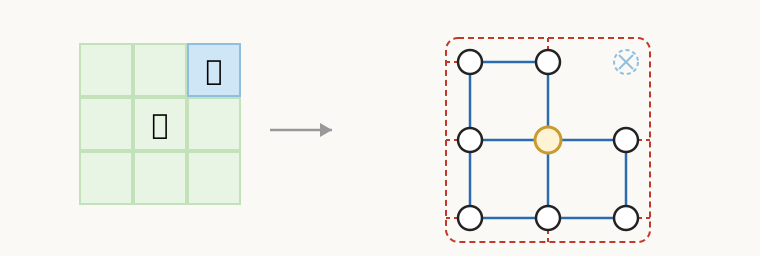
“Trap the horse” means we have to separate the horse vertex from the outside vertex by deleting cells. Since walls sit on cells, the walls we place form a vertex cut: a set of vertices whose removal leaves no path from to . The fewest walls is therefore the minimum vertex cut. This is solveable via Menger’s theorem: the minimum number of cells we must delete to separate from equals the maximum number of vertex-disjoint (or the number of escape points) paths the horse could take to escape.
The classic max-flow / min-cut theorem cuts edges, not vertices, so we can’t apply it directly. The solution is node splitting: replace each cell with an in/out pair joined by an edge whose capacity is the wall cost, and give the original moves infinite capacity. A minimum edge cut in the split graph can only sever those internal edges, so it corresponds exactly to a minimum vertex cut in the original description.
So we build the split graph, run max-flow, and the minimum cut tells us the fewest walls required in polynomial time. Good, but sadly not the game we are playing.
Maximizing the score
Trapping the horse is solved, but that was never really the game. You have walls, and your score is whatever you manage to seal off. So the real goal isn’t the cheapest trap; it’s the most valuable one.
Now we add the wall constraint back.
Unfortunately, the moment you have a budget, the question changes from if? to where?. Without a budget you always want the fewest walls (the minimum cut). But with walls to spend, the cheapest trap stops being the trap you want: you can afford to spend more, and spending more can wrap a bigger, more valuable field. So the min-cut answer is the wrong target.
To see why a longer fence is even a coherent idea, you can think of the trapping wall set as a loop. Any set of walls that seals the horse in forms a closed fence around it, and in the plane a closed curve splits everything into an inside and an outside (fancily, the Jordan Curve Theorem). The horse is stuck on the inside, and your score is whatever that inside contains.
So the real objective is:
i.e. maximize the value of the horse’s sealed-off region , using at most walls. To keep things simple, let’s start by treating every tile as worth one point — the goal is then just to enclose as many tiles as possible. We’ll bring the real scores back when we get to cherries.
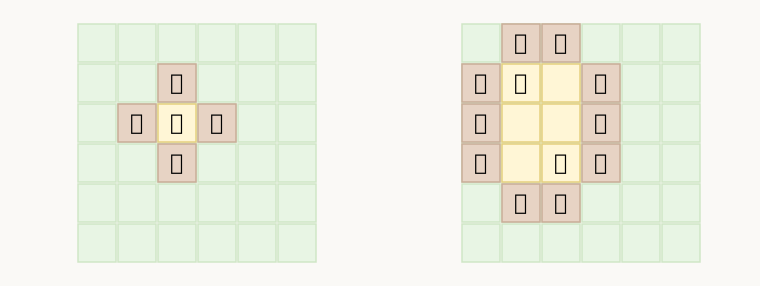
We switch from optimizing the loop to optimizing the area within. The value of a wall is now decided by the entire region left behind, not by the wall itself. We have stopped optimizing the fence and started optimizing the field.
The requirements are now to talk about which side each tile ended up on. For example, we can use two binary variables per tile:
- — do we place a wall on ? (your actual move)
- — is an escape route, i.e. still connected to the outside?
Maximizing enclosed tiles is the same as minimizing escape ones:
That last constraint is the whole trick. We need a linear way to say is escapable?. You can think of “escapability” as a disease creeping in from the outside, and we have to stop it from reaching the horse. A wall is the way to do that. Forcing means: no unwalled path may leak from the horse to the border. It’s the same idea as for the flow, but flattened into one inequality per edge.
minimize   sum(E[v] for v in tiles)
s.t.       sum(W[v] for v in tiles) <= k
           E[horse] = 0,  W[horse] = 0
           E[v] = 1 - W[v]              for v on the border
           E[u] >= E[v] - W[u]          for every ordered adjacent pair (u, v)
           W[v], E[v] in {0, 1}
Since the variables are integers, this is an integer linear program.
Cherries, golden apples, bees and portals
Now, if you have ever designed a game, you know how important it is to add some extras to make it more interesting. enclose.horse uses special tiles that change the gameplay (and hence the model) enough to frustrate you a bit longer. This game introduces the following:
-
Cherries (+3) and Golden Apples (+10) are just weights in the objective function. Swap the sum for a weighted and you are done.
-
Portals are just extra edges. The horse teleports between a paired set of portals, so in the graph you draw one edge joining them; escapability flows across that edge exactly the way the horse does. Intuitively, if you play the game with no model, portals are complex to grasp, because visualizing the connectivity is complex. Luckily, math does not care about this complexity, and this is very easy to model.
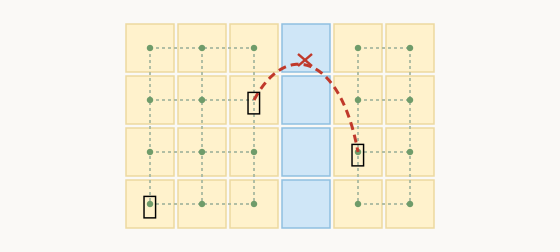
Bees (−5) are the one tile you would rather leave outside your fence, and that single negative number breaks an assumption we never stated: that every tile we can trap is worth trapping. Minimizing only behaves when every is positive.
If we flip one score negative the incentive inverts. The solver wants , because drops the objective by five. So it labels a fully walled-in bee an escape route, even though it is sealed on all four sides. Nothing forbids this, because every constraint we wrote only ever pushes escapability up () and never pins it down.
The obvious patch is to add the reverse: a tile may be escapable only if it is unwalled and has an escapable neighbor.
However, this is still not enough. The solver still wants , so it only needs some way to satisfy the new “must have an escapable neighbor” rule — and it can fabricate one. Picture a ring of tiles sitting in the enclosed region, each pointing at the next, all labelled “escapable”. Every tile in the ring has an escapable neighbor (the next one along), so the constraints hold, yet the ring touches the outside nowhere.
To kill this “invisible” ring we have to force escapability to actually reach the boundary. Give every escapable tile one unit of “proof of escape” that it must ship out to the outside vertex , travelling only through unwalled tiles:
Now a walled bee is trapped on paper too: every path from it to crosses a wall, so its unit of proof has nowhere to go and turns infeasible (impossible).
Solving
I implemented both models in Python with Google OR-Tools.
The code is on GitHub: ddesotto/enclose-horse-solver. It’s a small CLI you can point at the puzzle url:
uv run enclose-horse https://enclose.horse/play/2026-07-12 --mode solveReferences
- enclose.horse: How to Play
- ddesotto/enclose-horse-solver — the solver described in this post
- dynomight, Integer programming easily encloses horse
- enclose.horse discussion on Tildes
- Ahuja, Magnanti, and Orlin, Network Flows: Theory, Algorithms, and Applications